

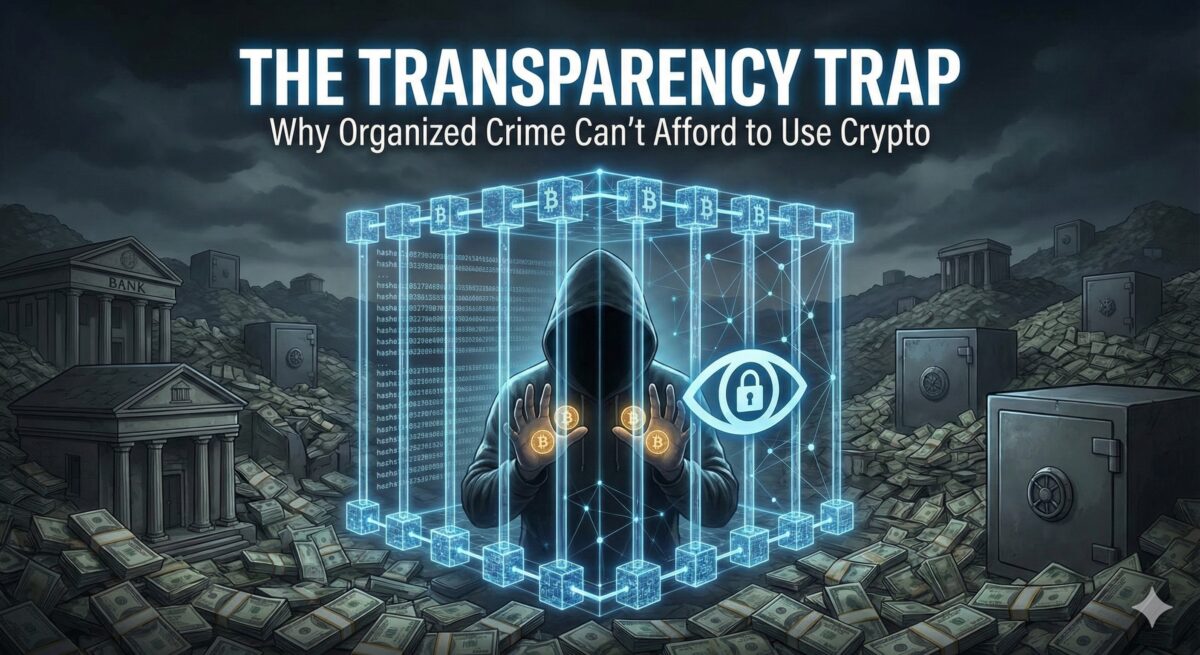
People tend to think of Bitcoin as the currency of the underworld. It’s a narrative that has been repeated so often, by regulators, by news anchors, by skeptics, that it has hardened into a kind of “zombie statistic.” It keeps walking forward no matter how many times the data kills it.
The prevailing view is that crypto is where the shadows are. If you’re laundering money or moving illicit goods, you must be using Bitcoin.
But if you look at the actual mechanics of criminal finance, that view falls apart.
In reality, the preferred tool for global organized crime isn’t a digital token on a public ledger. It’s the United States Dollar.
To see this clearly, you have to strip away the headlines and look at the structure of a criminal operation.
The Mechanics of Illicit Finance
Criminals run businesses. They have inventory, they have logistics, and they have payroll. And like any business, they optimize for specific conditions.
A cartel or a laundering syndicate needs three things from its currency: Liquidity, Stability, and Anonymity.
Bitcoin fails at two of these, and is terrible at the third.
Bitcoin is volatile. If you are moving $50 million in product, you cannot afford for your settlement layer to drop 10% while the truck is in transit.
Bitcoin is also radically transparent. This is the part that the “crypto is for crime” crowd misses. Every transaction is etched onto an immutable public ledger. If you are a criminal, using Bitcoin is the equivalent of robbing a bank and then writing your name in the guestbook on the way out.
The US Dollar, specifically physical cash and the traditional banking layer, offers the opposite profile.
Cash is final. It leaves no digital footprint. It has infinite liquidity. And most importantly, it vanishes.
The Data Doesn’t Lie
When you look at the raw volume, the gap is staggering.
According to the 2024 Nasdaq Global Financial Crime Report, an estimated $3.1 trillion in illicit funds flowed through the global financial system. That is roughly 2% to 5% of global GDP.
Compare that to cryptocurrency. The best estimates from blockchain analytics firms place illicit crypto volume between $45 billion and $50 billion.
That is a rounding error.
The traditional fiat system facilitates nearly 60 times more criminal activity than the entire crypto ecosystem combined. Yet the narrative persists that crypto is the problem.
Why? Because the old world is opaque, while the new world is transparent.
Think about the difference in visibility. If a cartel moves $100 million through a maze of shell companies, that money disappears into the noise of daily SWIFT traffic. Unwinding those layers isn’t automated; it is a forensic nightmare that takes years.
But if you move $10 million in Bitcoin? The entire market knows the moment you make your move because a Twitter bot flagged the wallet before the block was even confirmed.
Why the Dollar Retains the Crown
Criminals are pragmatic. They avoid volatility and absolutely avoid any move that can be traced as easily as a Bitcoin transaction.
They stick to the US Dollar for the same reason major institutions do: it is the global reserve asset, and it offers the deepest, most liquid market on earth.
Interestingly, when criminals do move to digital assets, they aren’t buying Bitcoin. They are increasingly moving to Stablecoins, digital tokens pegged to the Dollar.
This vindicates the underlying truth: They don’t want “crypto.” They want the Dollar. They just want a faster rail to move it on.
The Uncomfortable Trade-Off
This brings us to the uncomfortable reality.
We know the US Dollar is the preferred currency of drug trafficking, human trafficking, and money laundering. We know the traditional banking system is the primary rail for illicit finance.
But we do not ban the Dollar. We do not shut down the banking system.
We accept this as the cost of doing business. The utility of the Dollar—its ability to settle global trade, price oil, and stabilize economies outweighs the fact that it is also the perfect tool for a cartel.
The “old world” accepts this trade-off for itself, but refuses to extend that same logic to the new one.
Bitcoin isn’t a tool for criminals. It is a neutral, open settlement layer that is simply too transparent for the dark economy to use effectively.
The criminals have already made their choice. They are sticking with the Dollar.



Add your first comment to this post